Virtual Universes: Numerical Simulations
The Sherwood-Relics Suite
The Sherwood-Relics simulations (Puchwein, VI et al. 2023) represent a massive computational effort to model the Intergalactic Medium (IGM) during and after the Epoch of Reionization. Building on the legacy of the original Sherwood project, this suite utilizes the P-GADGET-3 code to provide high-resolution hydrodynamical snapshots across large volumes, specifically optimized to bridge the gap between high-redshift (z > 4) Lyman-α forest data and modern cosmological surveys. These Relics are named for their ability to capture the long-lasting thermal and ionization signatures, or relics, of patchy reionization. By incorporating non-equilibrium chemistry and varying ultraviolet background (UVB) models, the suite allows us to explore how different timing and morphology of reionization affect the transmission of distant quasar light, providing the necessary statistical power to interpret the increasingly precise data from instruments like DES and VLT spectrographs (UVES,X-Shooter,ESPRESO).
Explore Data Products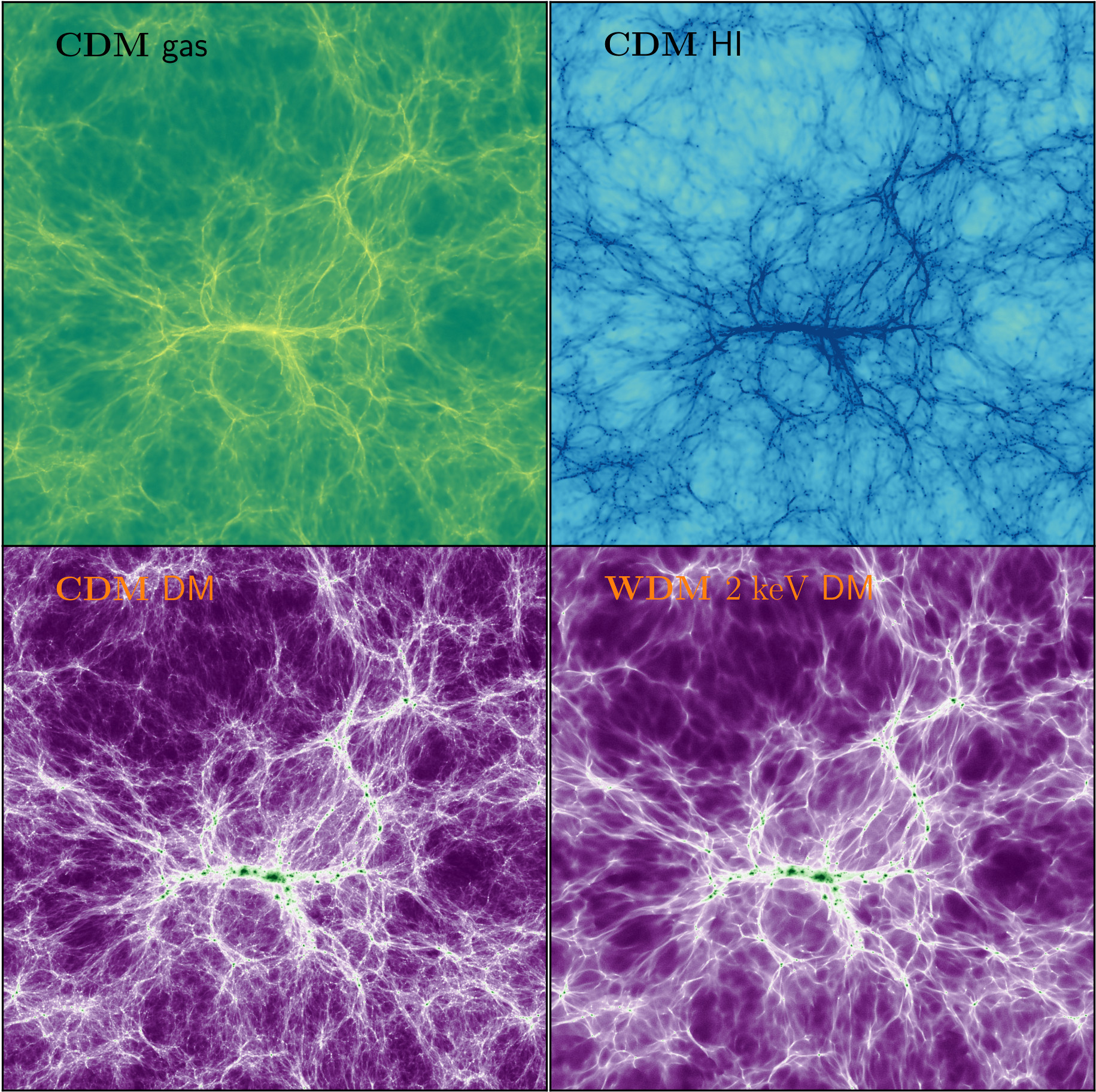
Baryonic Feedback: FABLE & xFABLE
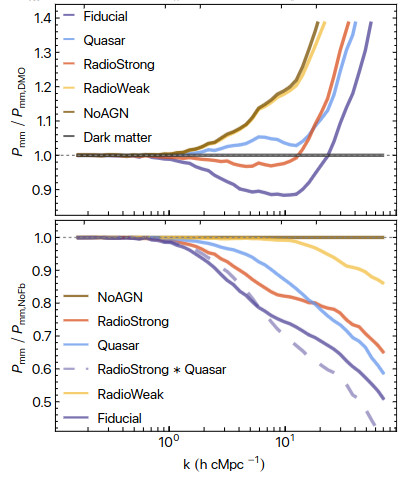
Understanding the large-scale structure of the universe requires accounting for baryon feedback - the process by which galaxy formation physics redistributes matter. Through the FABLE and xFABLE (extended FABLE) suites, we utilize the AREPO moving-mesh code to investigate how stellar and Active Galactic Nuclei (AGN) feedback suppress the matter power spectrum. In Martin-Alvarez, VI et al. 2024, we demonstrated that this suppression has a complex, non-trivial redshift evolution and is primarily driven by the high-mass tail of black holes at fixed halo or stellar mass; essentially, a small number of extremely massive AGNs are responsible for the bulk of the gas expulsion from dark matter halos. Furthering this in Bigwood, VI et al. 2025, we explored the xFABLE framework to tune AGN duty cycles and kinetic feedback modes. This allows us to match the observed gas profiles in galaxy clusters and the Sunyaev-Zeldovich effect while maintaining realistic galaxy stellar populations, providing a more robust calibration for the baryonic effects that challenges cosmic shear and weak lensing measurements.
The Engine of Discovery
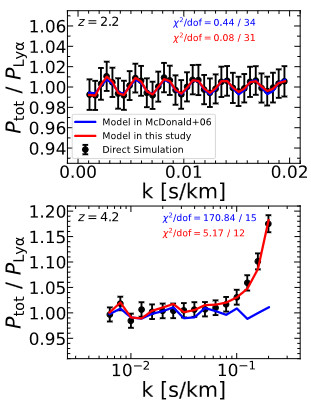
Precise cosmology demands rigorous control over astrophysical systematics. My work uses simulations to decouple these effects from fundamental physics. For instance, in Ma, VI et al. 2025, we modeled the cross-correlations of Si-III and other metal ions that contaminate the Lyman-α forest, which is essential for unbiased Baryon Acoustic Oscillation (BAO) measurements. Beyond standard cosmology, we apply these tools to search for new physics. In Nandakumar, VI et al. 2025, we examined how variable accretion onto supermassive black holes affects their spin evolution. We found that stochastic accretion can mimic or mask the signals of black hole superradiance, a key signature used to search for ultra-light axions, meaning that detailed astrophysical modeling is a prerequisite for any particle physics discovery in this regime. Finally, to provide physical intuition for these complex numerical results, I developed an absorber model (Iršič and McQuinn 2018) -- a semi-analytical halo-like framework that translates the continuous intergalactic gas into a distribution of discrete physical structures, clarifying how small-scale gas physics scales up to the 1D and 3D clustering observed in the forest.